
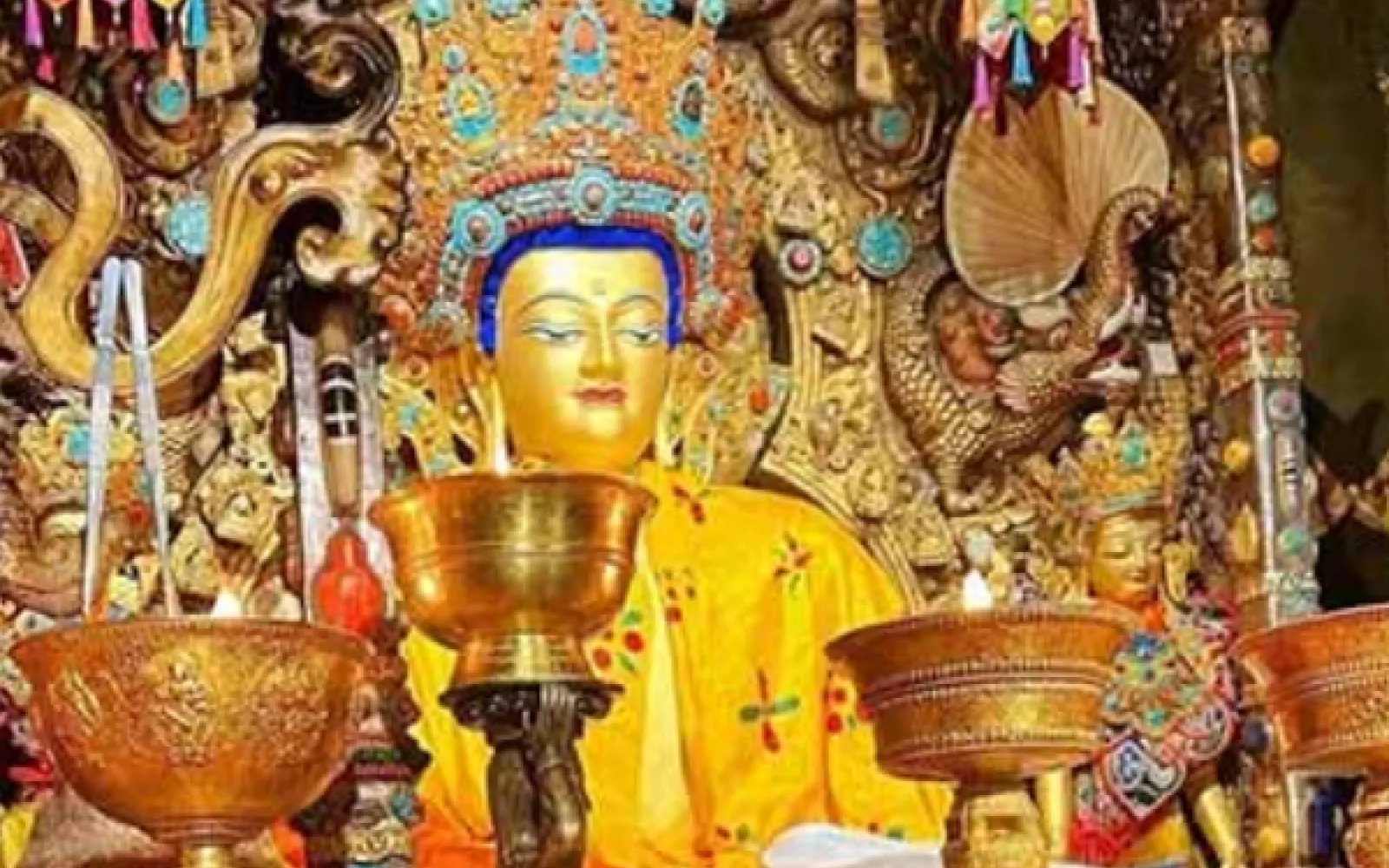
Nepal is more than a destination—it is a living crossroads of Himalayan culture, sacred landscapes, and ancient wisdom. Among its richest spiritual traditions is Tibetan Buddhism, a profound path rooted in the Mahāyāna tradition and fully embracing the Vajrayāna (Tantric) teachings. For travelers seeking deeper meaning alongside breathtaking scenery, exploring Tibetan Buddhism in Nepal offers a transformative journey of compassion, wisdom, and inner awakening.
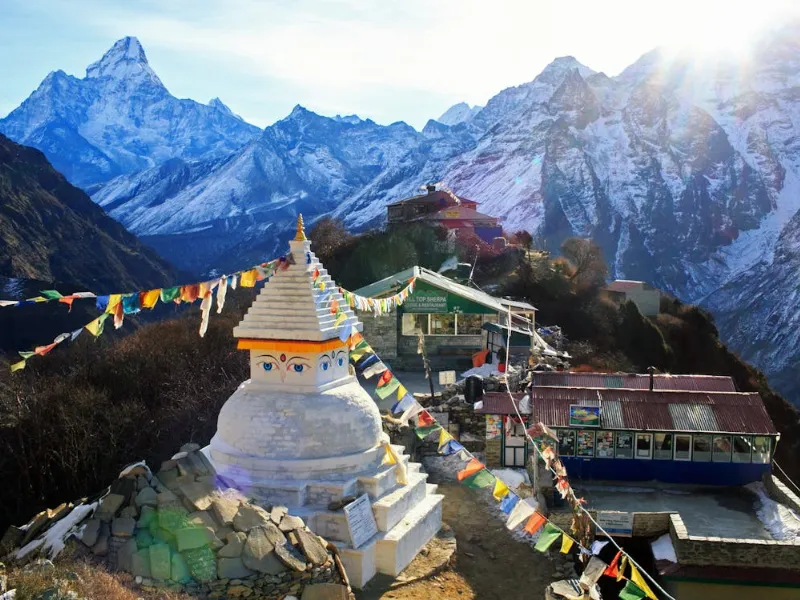
A Buddhist stupa adorned with prayer flags marks a monastery site along the Khumbu Region trekking route in Nepal, set against the snow-capped Himalayas.
Tibetan Buddhism preserves the core teachings of early Buddhism—such as the Four Noble Truths, karma and rebirth, impermanence, and non-self—while expanding them through the Mahāyāna vision of universal liberation. At its heart lies a commitment to awakening not just for oneself, but for all beings.
This altruistic motivation is expressed through bodhicitta, the “mind of awakening,” which inspires practitioners to walk the bodhisattva path—a life devoted to compassion and wisdom.
Throughout Nepal, travelers encounter sacred images and temples dedicated to revered bodhisattvas, each embodying a quality of enlightenment:
These figures are not distant deities but living symbols of qualities cultivated through meditation and ethical living.
One of the most influential pedagogical systems in Tibetan Buddhism is Lamrim (“Stages of the Path”), a structured presentation of the Buddhist path attributed to Atiśa (11th century) and later expanded by masters such as Gampopa and Tsongkhapa.
Lamrim teachings classify practitioners according to three scopes:
Lamrim serves as a comprehensive framework that integrates ethics, meditation, philosophy, and ritual into a single coherent path.
A defining feature of Tibetan Buddhism is its full embrace of Vajrayāna, also known as Tantra or Secret Mantra. Tantric Buddhism emerged in India around the 7th century CE and was preserved in Tibet with extraordinary completeness.
Vajrayāna is often called the “result vehicle”, because it takes Buddhahood itself as the path, using visualization, mantra, and ritual to transform ordinary experience into enlightened awareness.
Key features include:
Tantric deities appear in both peaceful and wrathful forms, symbolizing compassionate and forceful methods of awakening. While some tantric practices symbolically employ desire and aversion, others involve literal ritual transgressions, always governed by strict ethical commitments.
Philosophical Foundations: Madhyamaka and Yogācāra
Tibetan Buddhist philosophy is deeply rooted in Indian Buddhist thought, organized through the classical “Four Tenet Systems”:
Among these, Madhyamaka, founded by Nāgārjuna, is widely regarded as the highest philosophical view. It teaches that all phenomena are empty of intrinsic essence (svabhāva) and arise dependently.
Yogācāra philosophy also plays a major role, especially in Nyingma, Kagyu, and Sakya interpretations, where it is often viewed as complementary rather than inferior to Madhyamaka.
Tibetan scholasticism preserves vibrant debates on:
The relationship between conceptual understanding and meditative realization
Monastic debate, memorization, and philosophical analysis remain central to Tibetan Buddhist education, particularly in institutions such as Sera, Drepung, and Ganden monasteries. These methods are not merely intellectual exercises but are viewed as essential supports for direct realization.
Through this synthesis of ethics, philosophy, meditation, and ritual, Tibetan Buddhism presents one of the most comprehensive spiritual systems in the Buddhist world—deeply rooted in Indian Mahāyāna thought, yet uniquely shaped by Tibetan culture and history.
Further Readings: